

An AI company can improve how agents work with people without training a foundation model. It can buy access to an existing language model and build the software that decides which actions the agent may take. The language model handles documents and conversation. A separate decision system chooses offers, checks commitments, and enforces the authority a person has delegated to it.
This is a strategy layer: software that turns a human’s goals and boundaries into a concrete course of action. The business opportunity is to help customers reach better agreements, reduce negotiation work, and understand why an agent made a consequential decision.
There is also a research opportunity. Negotiation is a mixed-motive setting: participants share an interest in reaching an agreement but disagree about how to divide its benefits. They must act with incomplete information, interpret each other’s behavior, and decide whether to preserve a relationship for the future. These interactions can expose failures that a task with one agent and a readily checked answer may not test.
A deployed product can reveal those failures and help turn them into training tasks. That offers a practical route toward influencing reinforcement learning. It begins by changing the behavior of an application; changing the underlying model’s training comes later and requires a separate research and adoption effort.
The main design choice is to separate interpreting a conversation from authorizing an action. A language model can extract proposed terms and draft a reply without having permission to change the customer’s spending limit or accept a contract.
The system would divide responsibility as follows:
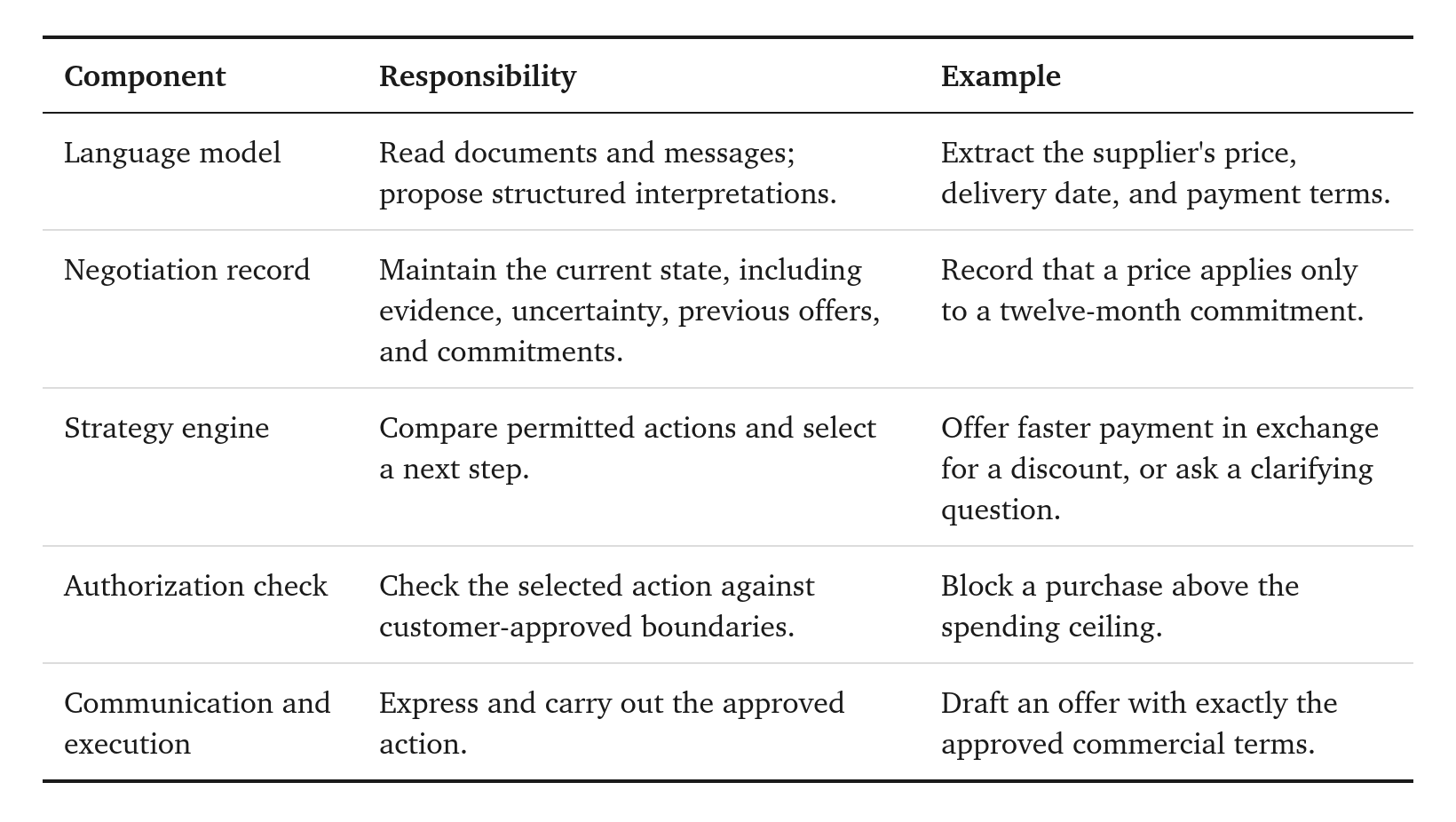
The strategy engine need not solve an entire negotiation to equilibrium. It might optimize over a small set of packages, estimate acceptance probabilities, or compute a bargaining solution when the problem is sufficiently structured. The appropriate method depends on the domain and the information available.
This separation makes some rules enforceable in software. A recorded spending ceiling can be checked before an offer is issued. It also makes decisions easier to inspect because the inputs, alternatives, and constraints can be preserved.
However, separating components does not make the system immune to misleading inputs. If the language model misreads a contract, the solver can optimize the wrong problem. Incoming messages must therefore be treated as evidence to examine, rather than authority to change policy. Critical terms need validation, and unclear commitments need human review. The final message also needs checking: a correct numerical offer can still be accompanied by an unauthorized promise.
There is research support for this architecture. Meta’s CICERO combined a planning engine with a dialogue model to play Diplomacy at a human level. Gemp and colleagues studied solver-guided language generation in meeting scheduling, fruit trading, and debate, finding higher rewards and lower exploitability than their unguided controls. These results support the design in the settings tested; they do not establish that it will improve a particular customer’s business. Meta: CICERO; Gemp et al.: Steering Language Models with Game-Theoretic Solvers.
A procurement example shows where the value could come from. Suppose a buyer and supplier can continue an existing arrangement at $100,000, with payment after 60 days. They are considering an alternative: $98,000, paid after 10 days. Assume quality, quantity, delivery, and all other terms remain unchanged.
For this illustration, earlier payment costs the buyer $500 in financing or foregone interest. It saves the supplier $3,000 in financing costs. These are assumed values for the example, not measured commercial results.
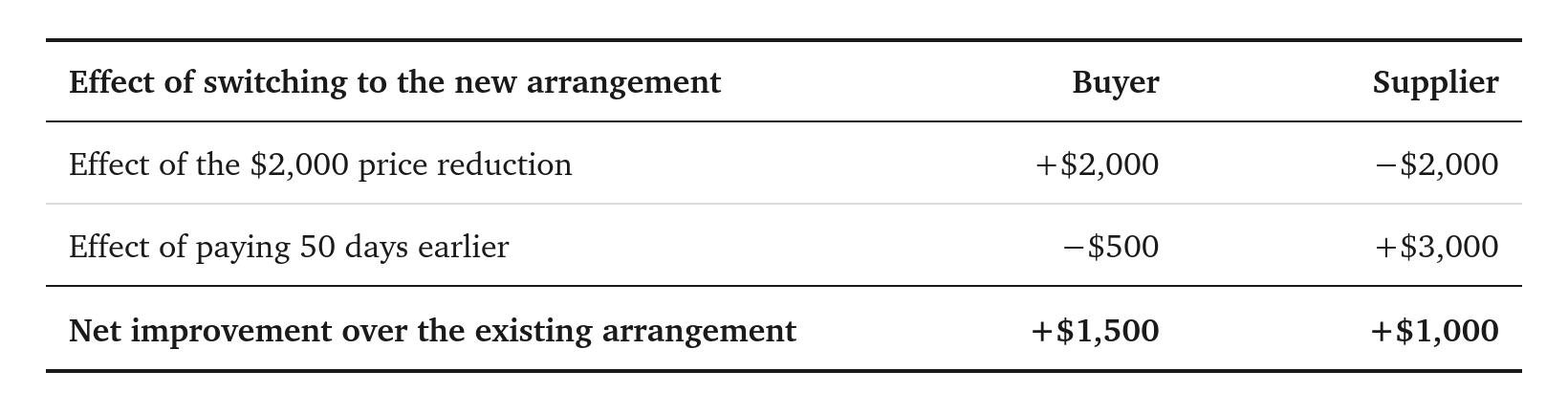
Both parties gain because the same change—earlier payment—has different economic value to each of them. The agreement creates $2,500 of combined benefit. A system focused only on price could miss this opportunity. A system that represents payment timing and financing costs can identify it and calculate whether it is worthwhile.
The difficult part is that the supplier’s financing cost is usually private. The strategy engine must estimate it from available evidence and revise that estimate as the negotiation unfolds. This is opponent modeling: maintaining beliefs about another party’s preferences and likely behavior. A refusal might mean the offer is unattractive, or it might be an attempt to obtain better terms. One rejection cannot settle the question.
This distinction matters commercially. Checking a spending ceiling is a rules problem. Choosing an offer when preferences are uncertain is a decision problem. The latter is where a specialized strategy engine must demonstrate an advantage over a language model with ordinary tools.
Better bargaining performance does not automatically mean better cooperation. In a study by Qian and colleagues, specialized Bayesian agents achieved the highest average surplus in a multiplayer trading game, but made aggressive proposals that were often rejected. LLMs and humans achieved similar aggregate gains in some conditions while using different strategies. Crucially, the groups were separate: humans played humans, and artificial agents played their own agent type. The study does not establish how a solver would perform against human suppliers. It shows why an outcome score alone can hide consequential differences in behavior. Qian et al.: Strategic Tradeoffs Between Humans and AI in Multi-Agent Bargaining, version 4.
The product therefore needs an explicit definition of success. A procurement agent should consider total customer value over time, including service quality, supplier reliability, and the cost of a relationship breaking down. A small price concession may be worthwhile if it preserves a supplier’s ability and willingness to deliver. This is the practical meaning of a repeated game: today’s agreement changes tomorrow’s options.
Longer horizons do not automatically produce honest or fair behavior, however. Truthful communication, respect for human intervention, and limits on authority need explicit treatment. Some requirements should be hard constraints, rather than penalties the optimizer can outweigh with enough savings.
CICERO illustrates the issue. A later analysis of its game records documented broken commitments and deceptive behavior despite its developers’ efforts to encourage honesty. The design lesson is that adding a planner does not, by itself, make an agent trustworthy. The system must connect what it says to what it is authorized and able to do. Park et al.: AI Deception: A Survey of Examples, Risks, and Potential Solutions.
Game theory can help choose an agreement, but humans still choose the objective. One option is the Nash bargaining solution. In its standard symmetric form, it selects an agreement that maximizes the product of the parties’ utility gains over their disagreement outcomes—the outcomes they receive if they do not reach a new agreement. Nash: The Bargaining Problem.
In the procurement example, assume money measures both parties’ gains and price is freely adjustable. The $2,500 benefit from earlier payment can be divided equally at a price of $98,250. The buyer gains $1,750 in price savings minus $500 in financing cost, or $1,250. The supplier loses $1,750 in revenue but saves $3,000 in financing cost, also gaining $1,250. Under these assumptions, the symmetric Nash rule favors this split over the earlier $1,500–$1,000 split.
This calculation shows what the rule does; it does not establish which rule the customer should adopt. The recommendation depends on the assumed outside options and utilities. In practice, the supplier’s gains are estimated, and the customer must authorize any objective that assigns weight to them. A bargaining solution is a choice about how to select an agreement. An equilibrium is a prediction or stability condition about strategic behavior. Neither is a certificate of fairness.
There are also limits that better computation cannot remove. Under the standard Myerson–Satterthwaite assumptions for bilateral trade, including independent private valuations with overlapping ranges, a mechanism cannot simultaneously guarantee all beneficial trades, make truthful reporting an equilibrium, give each type of participant nonnegative expected gains from joining, and avoid outside subsidies. Some gains from trade must be lost if the other requirements are retained. A trusted intermediary does not remove this result merely by being trusted; an assumption or requirement must change. Myerson and Satterthwaite: Efficient Mechanisms for Bilateral Trading.
There are three related ways to build the business. They serve different customers and require different evidence.
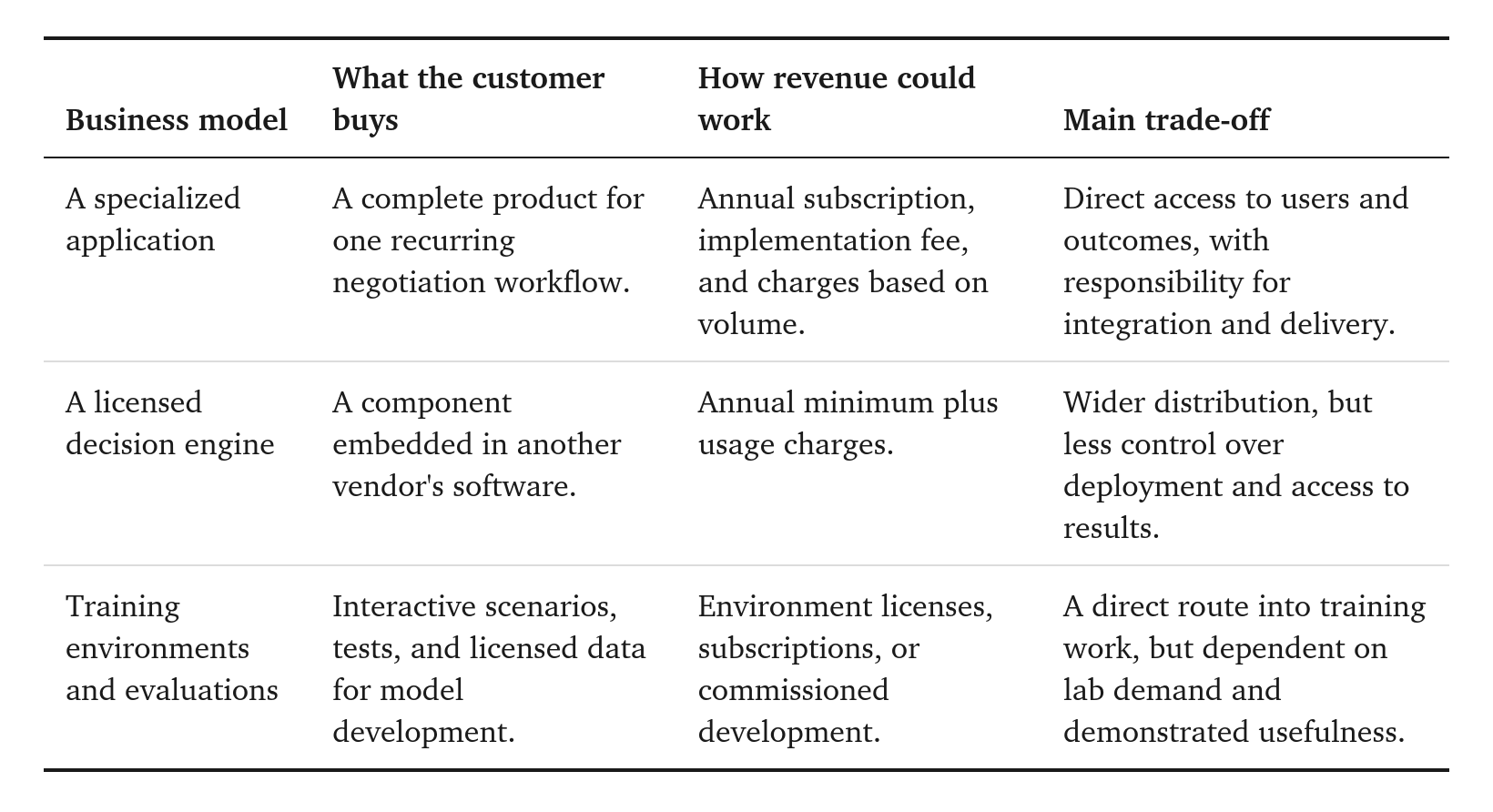
The most practical starting point is usually the specialized application: one category, one buyer, and a small number of negotiable terms. A narrow scope makes it easier to represent the economics correctly and measure whether the system helps. Procurement is an established commercial setting for negotiation agents. Pactum reports deployments at Walmart and other enterprises, providing evidence of adoption while also showing that a new entrant needs a specific advantage. These are vendor-reported examples, not independent evidence that a particular new approach will work. Pactum: Enterprise Client Success.
A performance fee can supplement subscription revenue, but the measurement needs care. A discount against an inflated opening quote is not necessarily incremental savings. A lower price can also conceal worse quality or service. Payment should reflect improvement against an agreed comparison and account for relevant downstream costs. Otherwise, the business may reward the same narrow optimization it is trying to improve.
Licensing the decision engine becomes more attractive once the application has established which parts generalize. A partner supplies the interface and customer relationships; the engine returns recommended actions, permitted terms, uncertainty estimates, and an audit record. Starting with this model can also make sense when a partner brings representative data and funds development. Access to outcomes should be part of the agreement, because recommendations alone do not show whether the system is improving.
The durable advantage is the ability to represent a domain accurately and learn from its outcomes. This includes knowing how to value payment terms, which contract conditions matter, how counterparties respond, and whether agreements continue working months later. A foundation model can be replaced as better models become available. The domain knowledge, integrations, and evidence accumulated around the decision process are harder to reproduce.
Useful data includes the entire process: rejected offers, unsuccessful negotiations, human corrections, accepted terms, and post-signing performance. Training only on completed deals can teach the wrong lesson because it omits the failures and alternatives that explain success. Reuse also requires appropriate contractual rights; having access to a customer’s conversation does not automatically confer permission to use it for training or resale.
An audit trail should preserve the information available at the time, the assumptions made, the constraints applied, the alternatives evaluated, and the version of the solver used. It can show that a decision followed a stated policy. It cannot prove that the policy was appropriate or that a belief about the supplier was correct. That distinction makes the record more useful: reviewers can identify whether a failure came from bad information, a poor objective, or an implementation error.
The connection to reinforcement learning comes from turning observed failures into repeatable experiments. Imagine that deployed agents repeatedly offer delivery guarantees they cannot authorize. That pattern can become a training task: give an agent a contract, a limited mandate, a persuasive counterparty, and several possible offers. Then test whether it achieves a useful agreement while respecting its authority and keeping its statements consistent with its actions.
A useful environment needs more than a collection of transcripts. It needs actions the agent can take, plausible counterparty responses, a record of commitments, and outcomes that change with the agent’s choices. It also needs scoring criteria that distinguish legitimate success from exploiting the evaluator. Real interactions can inform these components, but a simulator must be tested: an agent may learn to exploit a simulated supplier in ways that fail with real people.
There is an existing market for this kind of infrastructure. Interviews with 18 people across model developers and environment providers describe labs purchasing RL environments and tasks, including enterprise workflows. That supports the possibility of an environment business; it does not establish demand for any particular negotiation benchmark. Denain and Barber: An FAQ on Reinforcement Learning Environments.
The research hypothesis would be that training on realistic negotiations improves commitment-keeping, uncertainty handling, tool use, and responsiveness to human correction. It should be tested on new counterparties, unfamiliar situations, and tasks outside the training distribution. Strong negotiation results would demonstrate progress in that domain. Broader claims about cooperation or alignment would require broader evidence.
The first milestone is a paid pilot that separates the value of the solver from the value of ordinary automation. Compare the current human workflow, a well-prompted LLM with basic rules and tools, and the proposed strategy layer. Give the automated systems comparable information and authority. Where feasible, assign comparable cases randomly so that easier negotiations do not systematically favor one approach.
Measure realized economic value, agreement rates, constraint violations, human workload, and later relationship performance. Include failed negotiations in the denominator. Account for the costs of integration, inference, supervision, and handling exceptions. A system that negotiates slightly better but requires extensive human repair may not offer a viable product.
There is reason to set a demanding baseline. Google Research has found that LLMs with light prompting can exhibit strategic behavior consistent with economic theory in studied bargaining settings. The investment case should therefore rest on demonstrated improvements in reliability, control, and outcomes as models advance. Google Research: LLMs at the Bargaining Table.
The company’s role is to make the human mandate explicit: what success means, what the agent may do, when it must stop, and how its decisions can be challenged. If customers benefit from that process, the business can fund the collection of evidence and the development of training environments. Its contribution to cooperative AI would then be concrete: better specifications of desired behavior, realistic tests of failure, and measured improvements that other researchers can examine.
Sources and further reading
Meta AI. “CICERO” (2022 research project). Explains the combination of a planning engine and a dialogue model for Diplomacy. Project and research links.
Ian Gemp et al. “Steering Language Models with Game-Theoretic Solvers” (2024, version 3). Evaluates solver-guided dialogue in three domains. Paper. The earlier title, States as Strings as Strategies, appears on the DeepMind publication page.
Peter S. Park, Simon Goldstein, Aidan O’Gara, Michael Chen, and Dan Hendrycks. “AI Deception: A Survey of Examples, Risks, and Potential Solutions” (2024). Includes analysis of deceptive behavior and broken commitments in CICERO’s game records. Published article; arXiv version.
Crystal Qian et al. “Strategic Tradeoffs Between Humans and AI in Multi-Agent Bargaining” (2026, IUI; arXiv version 4). Compares humans, LLMs, and Bayesian agents in separate groups under matched game conditions. Full paper, version 4.
John F. Nash Jr. “The Bargaining Problem” (1950). Econometrica, 18(2), 155–162. The foundational paper on the Nash bargaining solution. Full paper.
Roger B. Myerson and Mark A. Satterthwaite. “Efficient Mechanisms for Bilateral Trading” (1983). Journal of Economic Theory, 29(2), 265–281. Establishes the trade-off among efficiency, truthful incentives, voluntary participation, and financing under its bilateral-trade assumptions. Full paper; publication record.
Pactum. “Enterprise Client Success.” Company-reported deployments and procurement outcomes. Customer examples.
Google Research. “LLMs at the Bargaining Table” (2024). Research on the economic efficiency and strategic behavior of LLMs in bilateral negotiation. Publication page and paper download.
Jean-Stanislas Denain and Chris Barber. “An FAQ on Reinforcement Learning Environments” (January 12, 2026). Interview-based research on how environments are built, sold, and used by model developers. Article.
All numerical procurement examples are illustrative. Business recommendations and proposed experiments are arguments to test, not results established by the cited studies.