

An AI can finish a task and still be a poor teammate. It can make a decision that belonged to a person, ignore an expert’s correction, or succeed only because a human quietly did most of the work. A score that records only whether the task was completed can miss all of this.
The business opportunity is to make those differences measurable. Build realistic tasks that people and AI must solve together, then develop a dependable way to judge the AI’s contribution. Sell access to that evaluation system, the environments in which it runs, and the training data it produces.
The most valuable asset would be the grader: the rules, evidence, and scoring process used to assess cooperation. The benchmark would provide a consistent set of tests for comparing models. Recorded sessions would supply examples, but the grader would determine what those examples teach.
This is a research and business hypothesis. Its decisive test is whether training against these scores improves performance with real people on unfamiliar tasks.
Why the reward needs to include teamwork
Solved problems, graded answers, and preferences between two responses are useful training signals. However, judging a finished answer does not necessarily reveal whether the model handled the interaction well.
Consider two assistants that produce equally good procurement plans. One identifies the missing information, asks the relevant specialist, and prepares the plan. The other repeatedly asks the manager what to do until the manager has effectively written it. The final documents might deserve the same quality score. The assistants’ contributions do not.
Reinforcement learning encourages behavior that earns reward. If useful cooperation has no dependable representation in that reward, researchers have less control over whether training improves it. Imperfect proxies are possible; the challenge is making them track what actually helps a team.
The objective should therefore include three questions: Did the team succeed? How much work did the human have to do? Did the AI cooperate appropriately?
Design tasks that reveal when cooperation matters
A useful environment should create situations in which essential information or decision authority is spread across participants. Putting a human beside an AI is insufficient if the AI already has everything it needs.
Imagine a simulated supply-chain disruption:
The AI can inspect inventory, compare suppliers, and calculate delivery options.
A logistics manager knows which customer deadlines can move.
A procurement specialist knows that an apparently available supplier cannot currently be used.
The manager has authority to approve spending above a stated limit.
Nobody begins with the whole picture. Midway through the exercise, a customer changes a deadline. A successful assistant has to discover the relevant constraints, explain trade-offs, update its plan, and obtain approval where required.
This setup reveals several distinct abilities. Does the AI recognize a gap in its knowledge? Does it ask the person who can fill that gap? Does it remember the answer? Does it revise a commitment when circumstances change?
The task collection must also contain situations where the AI should proceed independently. If supplier eligibility is already documented and the proposed action is within its authority, asking again can waste time. The desired skill is judging when another person’s involvement is useful or required.
Record enough context to understand each decision
The basic data item should be a complete work session. A reviewer needs to see:
The goal, starting conditions, participant roles, and decision rights.
What information each participant could access at each stage.
Messages, tool actions, shared-document edits, and changes in the environment.
Human corrections, approvals, interventions, and work performed.
The outcome and the reasoning behind the reviewer’s scores.
Without the information available at the time, a reasonable question can look unnecessary in hindsight. Without a record of human interventions, a successful outcome can conceal an ineffective assistant.
Practicing domain experts should help design scenarios and participate as teammates. Separate reviewers should assess performance, so that participation and grading are distinct responsibilities.
The collection process should also secure explicit permission from contributors and participating organizations for the intended commercial training uses. Realistic context, expert participation, and usable rights together make the sessions commercially useful.
Compare different continuations of the same situation
A transcript tells you what happened. To judge the value of a particular action, it helps to investigate what would have happened if the model had acted differently.
This is the purpose of branching: save the state at an important decision point, then run several continuations to an outcome.
In the supply-chain example, suppose the AI is about to recommend a replacement supplier. The procurement specialist has information the AI has not yet requested. The following are illustrative possibilities, not experimental findings:
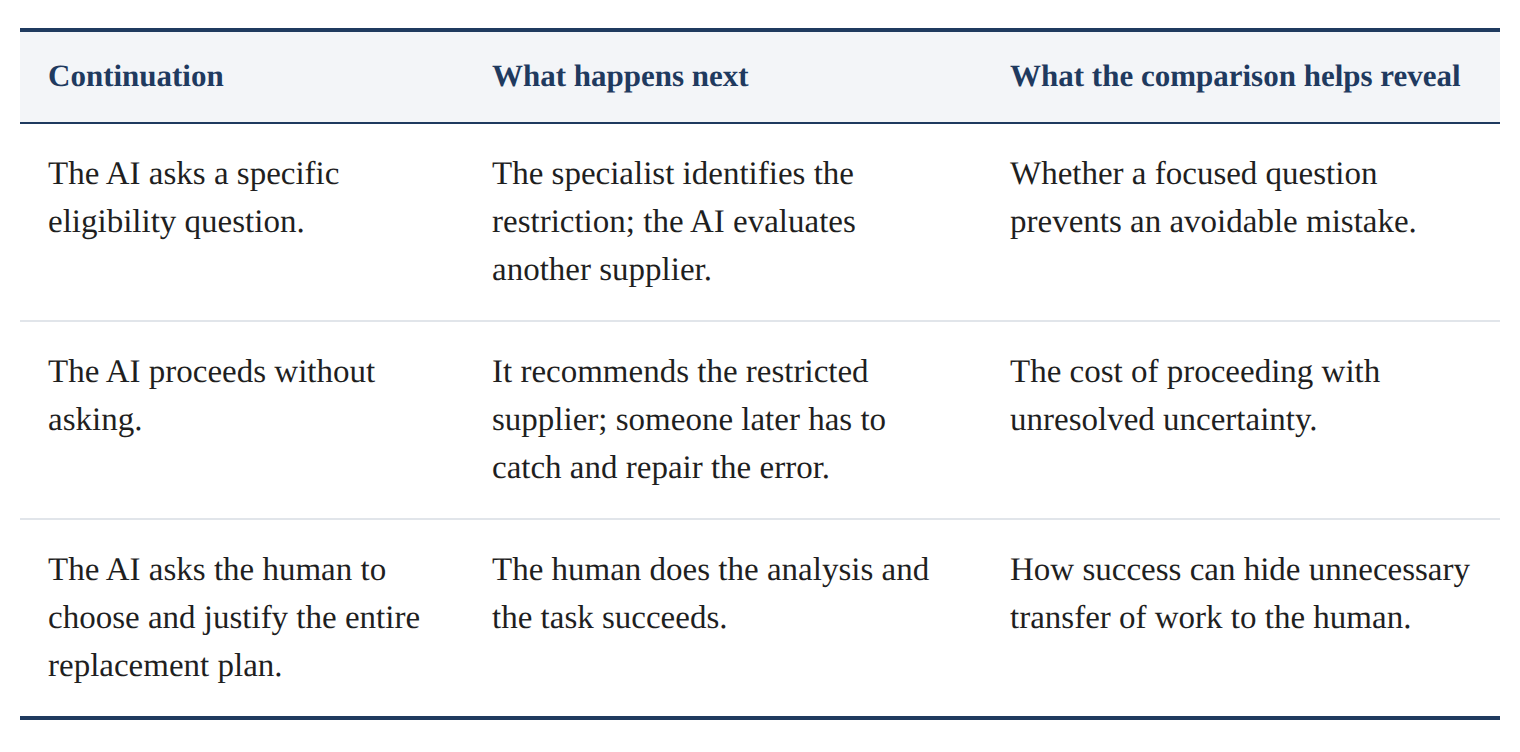
Other branches can test whether the AI incorporates a correction, or how the interaction changes when the human does not volunteer missing information. A separate task variant should make all necessary information available, so that independent action can receive credit too.
Branching makes the question more concrete: did an intervention change the result or reduce effort? It also makes scoring less dependent on whether a reviewer likes the model’s conversational style.
Branches do not automatically establish causation. Comparisons need matched starting conditions, a clearly specified change, and enough repetitions to account for differences between people and runs. Human participants can also remember previous attempts, so the evaluation must manage those carryover effects.
Keep three scores visible
A reliable grader should distinguish the result from the effort and behavior that produced it.
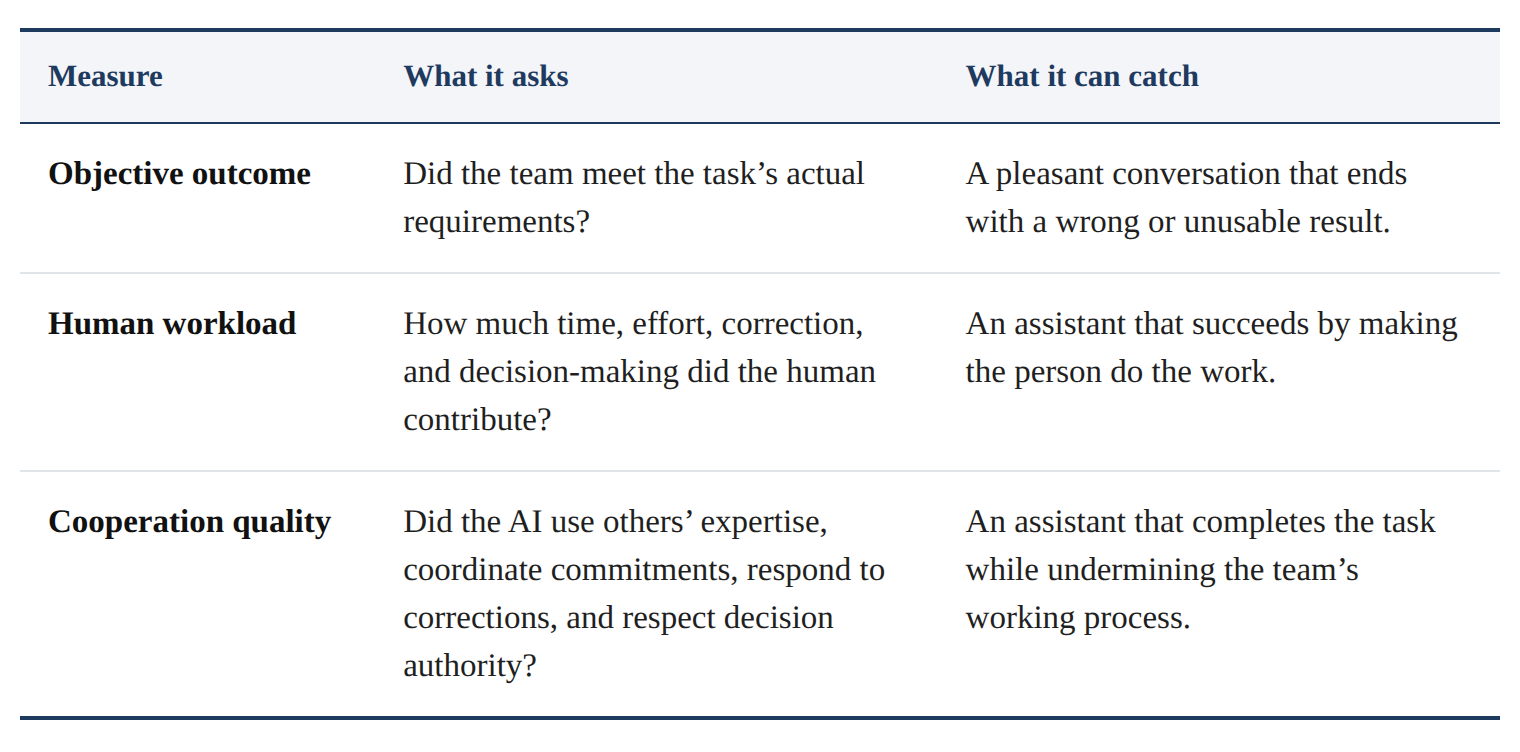
For example, suppose two systems each succeed on eight of ten tasks. One needs 40 minutes of human effort per task; the other needs 10. These hypothetical numbers illustrate a fourfold workload difference hidden by an identical success rate. Neither workload nor success alone tells us whether the AI respected the manager’s authority. A required approval can be good cooperation even when it takes extra human time.
The cooperation rubric—the explicit criteria used by reviewers—should reward observable behavior in context. Useful questions resolve uncertainty. Constructive disagreement identifies a problem and supports it with evidence. Keeping a commitment means doing what was agreed, or clearly renegotiating it when conditions change. Respecting authority means recognizing who may approve a decision while still surfacing concerns.
Collapsing everything into one headline score can hide these distinctions. A training algorithm may ultimately need a combined reward, but the component scores and the rules for combining them should remain visible. Any treatment of serious authority violations should be specified in advance.
Reviewers will sometimes disagree. Preserve their reasons, improve ambiguous criteria, and measure how consistently independent reviewers apply them. That consistency is called inter-rater reliability. It is necessary for a dependable grader, although agreement alone does not prove the criteria measure useful cooperation.
Over time, the valuable asset becomes a tested body of judgments: examples, exceptions, disagreements, and evidence connecting scores to team performance. That is harder to reproduce than a set of task prompts.
What existing research establishes
There are already useful foundations for this work:
Shared environments can support collaboration research. Collaborative Gym provides environments in which humans and agents communicate and act together, with both simulated and real-user conditions. It evaluates the process as well as the result. This demonstrates a practical framework for collecting and studying joint work. Collaborative Gym.
Shared understanding can be tested. Researchers at Microsoft Research and Harvard introduced a collaborative puzzle benchmark in February 2026. It examines how people and AI establish shared understanding, coordinate references, and repair misunderstandings. A human–AI study reproduced some established patterns from human collaboration and revealed differences. This supports a focused measurement approach; it does not establish broad workplace competence. Common-ground benchmark.
Some help-seeking behavior appears trainable. Scale reports that reinforcement learning improved a 32-billion-parameter model’s Ask-F1, a measure of help-seeking quality, by 28 percentage points on SQL tasks and 17 on software-engineering tasks, alongside improved task pass rates. It also reports transfer from SQL training to software-engineering help-seeking. These findings support feasibility for a specific behavior, while leaving broad transfer to real human partners unresolved. HiL-Bench.
Taken together, these sources support building and testing the proposal. They do not establish that a general cooperation grader is already reliable, that simulated partners adequately represent people, or that customers will pay enough to support the business.
Use simulated partners for volume, and people to test transfer
Repeated reinforcement-learning training requires many complete attempts, often called rollouts. Having a practicing expert participate in every attempt would be difficult and expensive. Simulated partners make higher-volume training possible.
That introduces a central research risk: the AI may learn habits that work with the simulator but fail with people. A simulated manager might always respond clearly, never overlook a message, or reveal missing information in a predictable way.
A practical design would use real experts to establish behavior at important decision points and to run evaluations. Simulated partners would support repeated training between those checks. Scheduled tests with unfamiliar real participants would then measure whether the gains survive.
The crucial measure is performance improvement with real people on unseen tasks, compared with a suitable baseline. Success against the simulator is useful diagnostic evidence. Success with new people is what supports the product’s central claim.
Those transfer tests should retain all three measures. Better outcomes that require substantially more human effort, or depend on ignoring decision rights, would not meet the intended standard.
Where a new business could compete
Expert data and realistic training environments are already competitive markets. Existing offerings include:
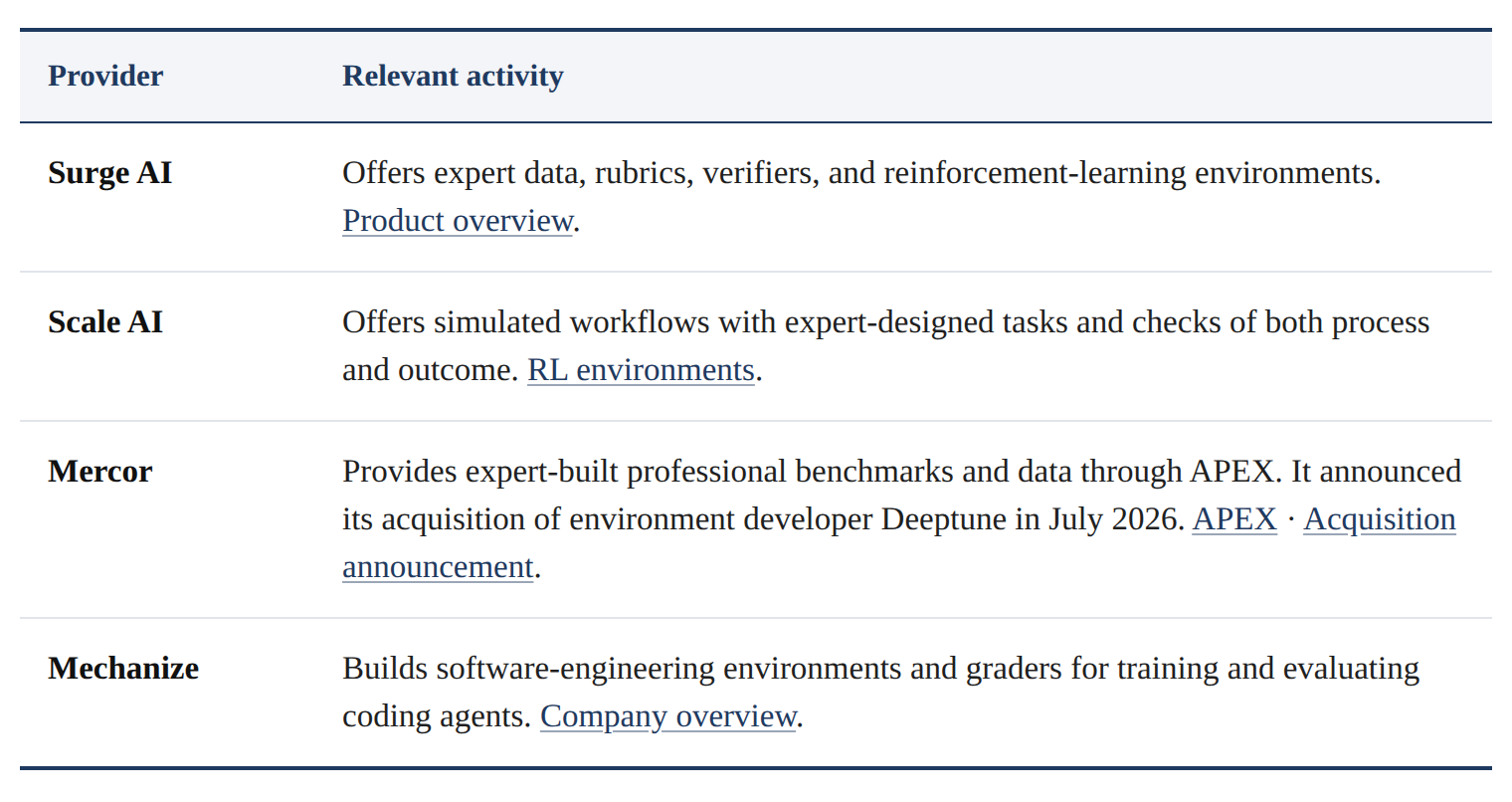
A January 2026 market overview describes Surge as a leading incumbent and reports customer departures from Scale following Meta’s investment. A July analysis interprets Mercor’s Deeptune move as an expansion into training infrastructure. These provide commercial context, distinct from evidence about cooperation itself. FourWeekMBA market overview · Futurum analysis.
Given these offerings, collecting expert conversations is unlikely to be enough to distinguish a new supplier. The opportunity to test is a specialized grader whose scores predict better human–AI teamwork.
Its defensible strengths would be distinctive families of tasks, a rubric that independent reviewers can apply consistently, and published evidence of improvement with real human partners. If researchers adopt the benchmark as a useful comparison standard, that adoption could create demand for the environments and data used to improve performance. Adoption and demand still have to be earned.
Build revenue around evaluation and repeat use
Three complementary products could support the business:
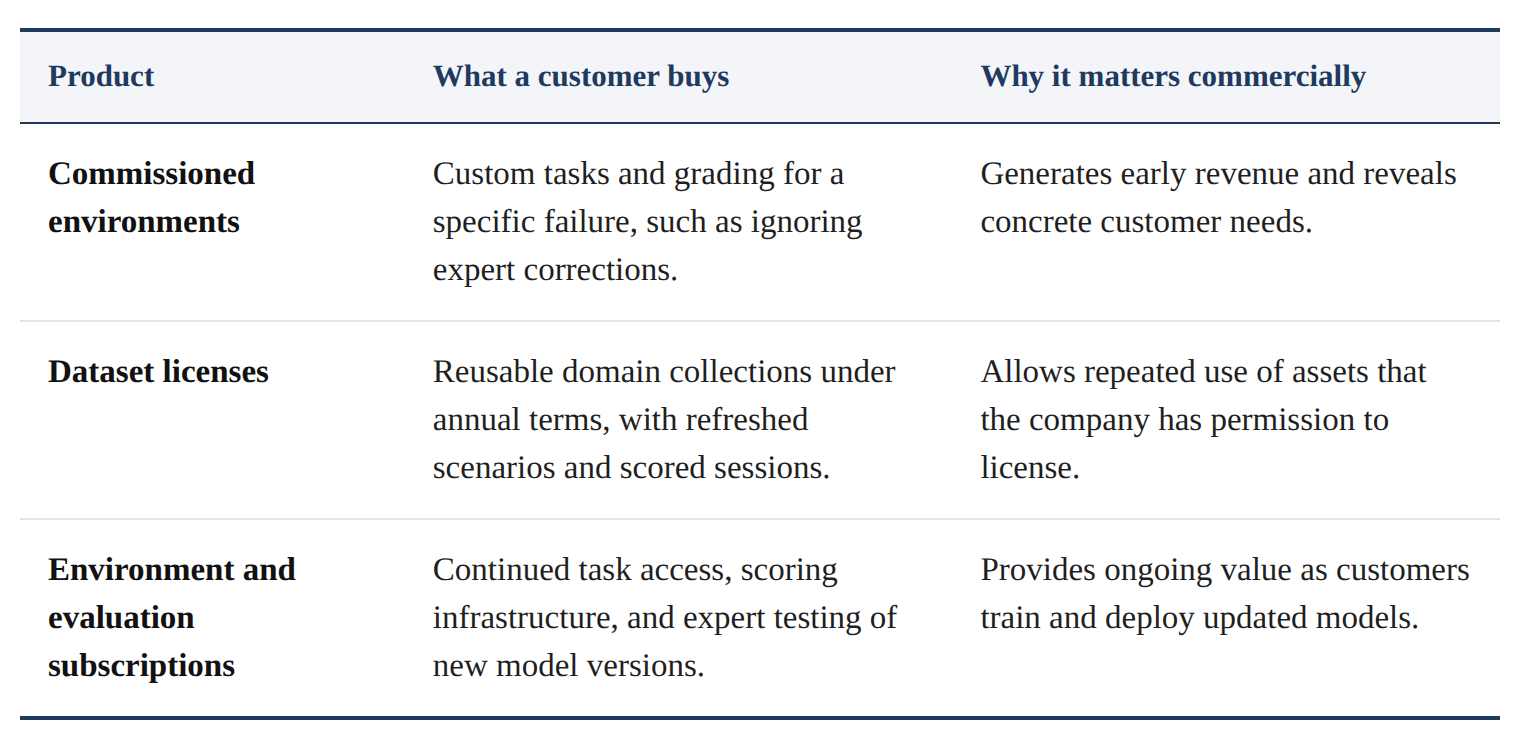
The starting point would be a paid custom project. Its reusable methods could support later products, subject to the customer’s agreement and the relevant data rights.
Potential buyers include frontier labs, teams adapting open-weight models, and enterprises deploying domain-specific agents. Evaluation is a plausible first purchase: a customer may want to discover where its assistant fails before committing to further training.
The proposed exclusivity policy protects that path. A customer could pay for exclusive access to particular task instances or sessions. The company would retain the ability to reuse its general rubric, benchmark framework, and transfer-testing methods across customers. Selling exclusivity over those core methods would restrict both the reusable business and the benchmark’s wider influence.
Run a pilot that can support or reject the idea
Start in one domain with credible experts and outcomes that can be measured. Compare two versions of the same base model: one receiving ordinary domain training, and one receiving training that uses the cooperation data and grading system.
The comparison needs a clear experimental design:
Define success before training. Specify task outcomes, human workload measures, cooperation criteria, and authority boundaries.
Make the budgets comparable. Account for training resources, expert input, and the time and tools available during evaluation. Keep other differences controlled where practical.
Reserve unseen tasks and unfamiliar partners. Evaluation scenarios and participants should be separate from training. Reviewers should not know which model version they are grading where feasible.
Report the three measures separately. Include uncertainty and variation across tasks and people, so a few favorable sessions cannot carry the conclusion.
Check whether the gains generalize. Repeat a successful result with a second model and then in a second domain.
The desired result is better team outcomes at a comparable budget, less human burden, and preserved human decision authority. If the only gain is a higher score from the training grader, the experiment has not established the benefit that customers need. If several parts of the training setup change together, the result supports that package; additional comparisons are needed to isolate the grader’s contribution.
Why this could influence model behavior
When task completion is the dominant reward, training can favor behavior that bypasses inconvenient human input. It can also overlook how much work people contribute to making the system succeed.
A trusted cooperation benchmark would make those costs visible. A usable grader would let researchers incorporate them into post-training, while evaluations with real people would check whether the resulting behavior is helpful outside the training setup.
The commercial ambition and the research ambition therefore depend on the same evidence: a measurable improvement in what people and AI accomplish together. If that evidence holds, the business would supply both training material and a credible standard for deciding which behavior deserves reward.
Sources and reading guide
Links were checked on September 20, 2026. Research findings, company descriptions, and market commentary serve different purposes; the notes below identify what each source supports.
Yijia Shao, Vinay Samuel, Yucheng Jiang, John Yang, and Diyi Yang. Collaborative Gym: A Framework for Enabling and Evaluating Human-Agent Collaboration. First posted December 20, 2024; revised August 8, 2026. Research on shared environments and evaluation of collaboration processes and outcomes.
Christian Poelitz, Finale Doshi-Velez, and Siân Lindley. A Benchmark to Assess Common Ground in Human-AI Collaboration. February 24, 2026. Research on shared understanding, coordination, and repair in a collaborative puzzle task.
Mohamed Elfeki, Tu Trinh, Kelvin Luu, Guangze Luo, and Matthew Siegel, Scale AI. HiL-Bench: Your Agent is Smart. It Just Won’t Ask for Help.. April 20, 2026. A company research summary reporting improvements in clarification behavior and task success; includes links to the paper, data, and code.
Chetan Rane, Scale AI. The Next Frontier of Data Training: RL Environments. February 27, 2026. Primary description of Scale’s environments, expert-designed tasks, and verification approach.
Mercor. APEX Benchmarks. A maintained benchmark portal with links to research, data, and code. Documents expert-built evaluations of professional tasks.
Gennaro Cuofano, FourWeekMBA. The Competitive Landscape: Players in the RL Environment Economy. January 15, 2026. Secondary market commentary covering Surge, Scale, Mercor, and environment specialists. Useful for dated competitive context, rather than establishing current revenue rankings or research results.
Futurum Group. Mercor Bets on Real-World AI Training: Will Environments Decide the Next AI Leaders?. July 10, 2026. Secondary interpretation of the Deeptune acquisition and the market for training environments.
Brendan Foody, Mercor. Mercor to acquire Deeptune. July 9, 2026. Primary announcement explaining how Mercor’s expert network and Deeptune’s environment technology fit together.
Mechanize. Company overview. Primary description of its coding environments, evaluations, and graders.
Surge AI. Products. Primary description of its expert data, reinforcement-learning environments, rubrics, verifiers, and human evaluations.